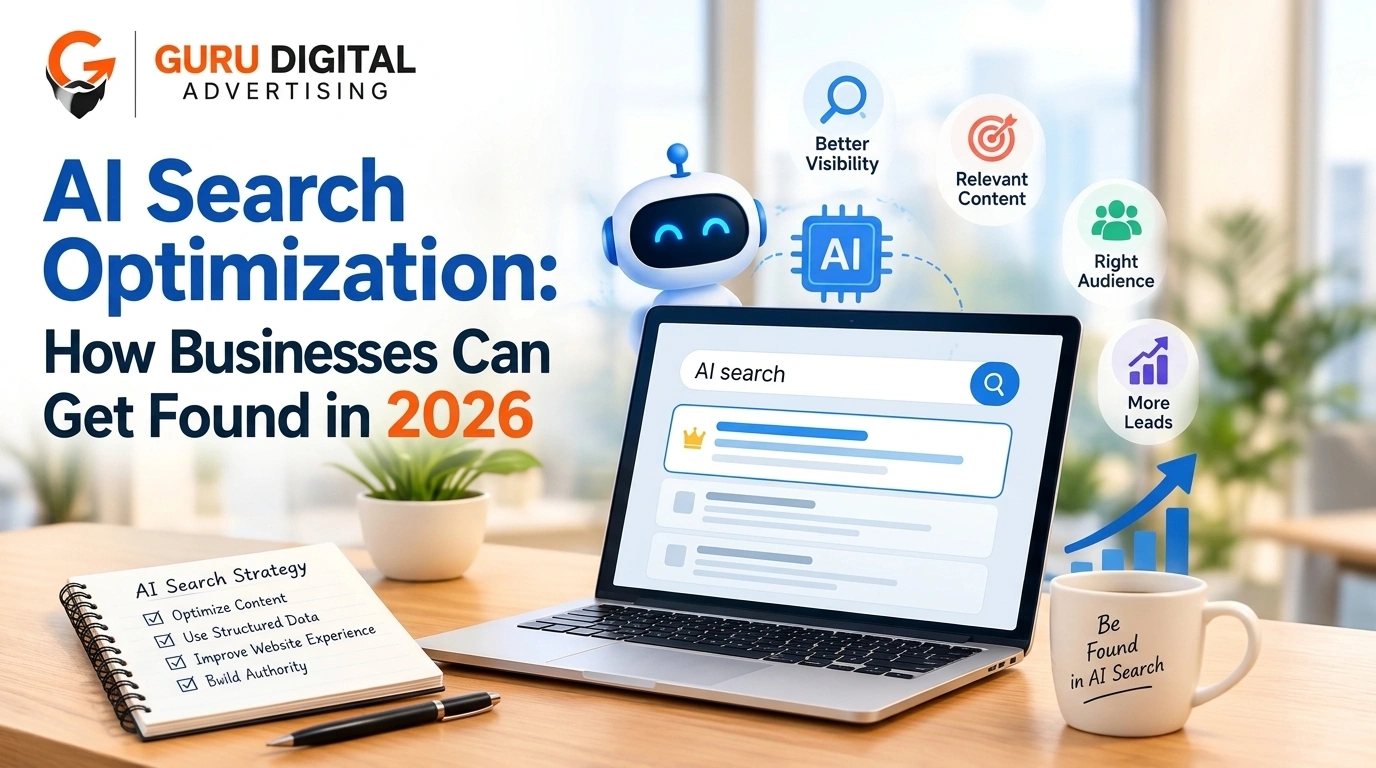
AI Search Optimization: How Businesses Can Get Found in 2026
- What Is AI Search Optimization?
- Why Is AI Search Optimization Important in 2026?
- How to Optimise Technical Structure, On Page or Off Page
- 5 Ways to Improve AI Search Optimization for Your Business
- AI Search Optimization vs. Traditional SEO
- How Guru Digital Advertising Can Help Businesses Get Found in 2026
- Conclusion
- Frequently Asked Questions
Today, consumers are visiting Google AI Overviews instead of clicking on links from traditional search engines because they can access all the required information straight away. Moreover, they are actively making use of AI assistants and conversational models in their daily routines. As a result, preparing your content for AI discovery has emerged as a vital necessity for every modern business, opening an entirely new frontier in parallel to conventional SEO.
That is why AI search engine optimization has become so crucial. Customers are often completely satisfied with the AI overview displayed at the very top of search engine result pages. Businesses must adapt their content in a way that allows it to reach users and fulfill their immediate needs. In this blog, we will explain what AI search optimization is, why it has become essential in 2026, and actionable steps to improve your website's visibility across modern AI engines.
What Is AI Search Optimization?
AI search optimization is a strategic method where a business owner optimizes their website directly for the customer experience and user intent. When an owner crafts content that truly provides quality details about their brand, products, and services, they are optimizing for the precise intent of the customer—fulfilling their necessity with clarity.
Key Takeaway: AI Optimization Core
As per Google's 2026 algorithms, your content must be genuine, adhere strictly to E-E-A-T (Experience, Expertise, Authoritativeness, and Trustworthiness) standards, and remain straightforward, transparent, and genuinely helpful.
Apart from optimizing your website content—whether it involves text, images, or technical SEO—it is equally crucial to ensure your brand reaches and gets cited by AI chatbots and generative engines like ChatGPT, Gemini, Claude, and Perplexity. Aligning with an experienced digital marketing company ensures your brand stays ahead of these algorithmic changes.
Why Is AI Search Optimization Important in 2026?
In the past, doing business was simple: set up a website, implement standard on-page keywords, and build backlinks to rank. But that alone is no longer enough. Modern businesses must produce content that perfectly fits user intent and solves actual problems without friction. It is time to prepare content for Answer Engine Optimization (AEO) and Generative Engine Optimization (GEO).
AI search has fundamentally changed how customers look for products and services on Google. People want detailed answers without having to click through multiple websites, which is why Google introduced AI Overviews. However, notice that the websites Google sources its information from are listed prominently alongside the overview. These can be any authoritative website—and if your content provides genuine utility, it could easily be yours.
Google values useful, human-written content. When you create valuable content with in-depth research and competitor analysis, search engines reward your domain with top visibility. Keep the following four foundational pillars in mind when optimizing your content:
1. Customers Are Performing More Conversational Search
Queries are increasingly typed or spoken as complete sentences rather than isolated keywords. For instance, instead of searching for "digital marketing company", users now search for "digital marketing firm that can assist small enterprises in generating top quality sales leads on a very low budget." Companies that answer these complex queries with targeted, valuable content will make their websites far more relevant to AI engines.
2. Search Visibility Goes Beyond Traditional Rankings
A website can now be discovered through multiple avenues: classic organic search rankings or direct citations in AI answer snapshots. Turning up in one channel does not automatically imply inclusion in the other. Publishing worthwhile content and maintaining an easily accessible technical website enables businesses to compete across multiple search experiences simultaneously.
3. Trust and Credibility Count
In order for AI engines to deliver accurate responses, they rely on concrete facts. Well-defined service descriptions, reliable business details, professional-quality content, and verified sources build confidence with both users and AI scrapers, greatly enhancing your website's utility.
4. Customers Need Clear Answers Before Making Decisions
Most prospects investigate a service thoroughly before reaching out. Providing transparent information on pricing, workflows, pros and cons, and detailed FAQs empowers customers to make informed decisions. For small companies, this is an unmatched opportunity to educate and build trust before the first phone call or email.
How to Optimise Technical Structure, On Page or Off Page
Many marketers have asked, "Is SEO Dead?" But you cannot get your website ranked on Google—or cited inside AI answers—if search spiders cannot locate and understand it in the first place. That is why professional SEO services have not died and will never die.
To maximize your presence for AI search engines, you must address every critical on-page factor: meta tags, image optimization with descriptive alt tags, clean internal linking architectures, and deep content optimization. Additionally, building authoritative backlinks protects domain health and signals trust to Google. On the technical side, focus on blazing-fast page load speeds, clean robots.txt directives, canonical tags, updated XML sitemaps, mobile responsiveness, and 404 error mitigation.
5 Ways to Improve AI Search Optimization for Your Business
Businesses do not need to abandon traditional SEO to thrive in AI search. Instead, strengthen your existing strategy by emphasizing content quality, technical accessibility, and customer-first solutions:
A. Make It Helpful, People-First Content
Good content solves real problems rather than solely catering to web crawlers. Before publishing, ask yourself what your target audience genuinely wants to learn. Explain complex subjects in accessible language, share actionable tips, and provide practical examples. For example, a digital agency might create an in-depth guide on deciding between SEO or Google Ads, breaking down exact pros, cons, and budget considerations. Avoid churning out repetitive content just to rank—Google's algorithms reward people-first utility.
B. Address Particular Customer Inquiries
Content that directly resolves specific user questions performs exceptionally well in AI search summaries. Answer each inquiry within a dedicated section with a clear heading and concise, high-value explanations. Relevant questions for a marketing agency include:
- How can SEO benefit small businesses? Long-term visibility, compounding organic traffic, and lower customer acquisition costs.
- How long does SEO take to produce results? Typically 3 to 6 months depending on competition, technical health, and content quality.
- What does a digital marketing service consist of? SEO, paid advertising, content marketing, social media management, and web development.
- How much should a small business spend on Google Ads? Budgets vary based on industry CPCs, usually starting with targeted local campaigns.
- How do you assess marketing performance? By tracking ROI, qualified leads, organic conversion rates, and lifetime customer value.
C. Develop Your Traditional SEO Skills
AI search optimization is built directly on top of SEO fundamentals. Search engines must continue to crawl and index web pages effortlessly. Ensure your site features descriptive title tags, compelling meta descriptions, hierarchical heading structures, natural internal link paths, and clean URLs. Regularly audit Google Search Console for indexation bottlenecks, crawl errors, and query impressions.
D. Use Clear Headings and Content Structure
A well-structured page enables readers and AI scrapers to navigate seamlessly and comprehend the core message instantly. Use a single H1 heading for the page topic, clear H2 headings for primary sub-sections, and descriptive H3 tags for granular points. Structured data and logical layout allow AI algorithms to parse semantic relationships across your content effortlessly.
E. Maintain Standard Business Details (NAP Consistency)
Accurate business information allows customers and AI platforms to locate and verify your brand without confusion. Maintain strict Name, Address, and Phone (NAP) consistency across your website, Google Business Profile, directories, and social platforms. Local businesses must keep categories and operating hours up-to-date, while nationwide companies should clearly define coverage areas and service offerings.
AI Search Optimization vs. Traditional SEO
Traditional SEO and AI search optimization share common foundations, but they emphasize distinct facets of online discovery. Here is how they compare:
| Traditional SEO | AI Search Optimization |
|---|---|
| Focus: Organic search rankings and SERP click-throughs | Focus: Visibility in AI-generated answers, citations, and conversational overviews |
| Keyword Strategy: Targets keyword volumes, head terms, and exact search intent | Keyword Strategy: Addresses natural language, multi-sentence conversational queries |
| Foundation: Emphasizes crawlability, indexability, and backlink authority | Foundation: Relies on technical crawlability while prioritizing semantic depth and clear facts |
| Metrics: Evaluates rankings, impressions, clicks, bounce rate, and goal conversions | Metrics: Tracks AI citations, brand mentions, referral traffic, and answered inquiries |
| Content Model: Builds content around search volume demand and keyword clusters | Content Model: Builds people-first, authoritative content that provides verified answers |
These approaches are completely complementary. Businesses should never sacrifice proven SEO best practices to chase unverified AI optimization shortcuts.
How Guru Digital Advertising Can Help Businesses Get Found in 2026
At Guru Digital Advertising, we believe sustainable business growth is driven by robust SEO architectures, clean content, and a deep understanding of customer intent. Our comprehensive digital marketing solutions assist businesses across the USA with SEO, content marketing, Google Ads management, social media marketing, and modern web development.
We build compelling web assets that showcase your products and services while giving users immediate, helpful answers to their questions. Want to boost your search rankings and get recommended by AI search engines?
Ready to Future-Proof Your Search Visibility in 2026?
Partner with Guru Digital Advertising to optimize your website for Google AI Overviews, generative search engines, and high-converting organic search.
Get Started With Guru Digital Advertising — Contact UsConclusion
For search visibility in 2026, the guiding principle is clear: optimize for genuinely helpful content, concise answers, and authoritative, accurate business data. Concentrate on overall usefulness and transparent expertise.
While no one can guarantee an instant shortcut to AI citations, brands that consistently publish trustworthy, well-structured information make their websites far more appealing to both users and intelligent algorithms. Integrate your traditional SEO foundation with a customer-first content approach, track meaningful metrics, and continuously adapt as search behavior evolves.
Frequently Asked Questions
1. What is AI Search Optimization?
AI Search Optimization is the practice of refining a website's content, technical structure, and business data so AI-powered search platforms can easily understand, synthesize, and cite it in conversational answers. It builds upon traditional SEO with an elevated focus on concise answers, verified facts, organized formatting, and authoritative credibility.
2. How is AI Search Optimization different from SEO?
Conventional SEO focuses on ranking web pages in organic search listings to drive direct website clicks. AI Search Optimization considers how content is quoted, summarized, and referenced inside conversational AI answers and AI Overviews. The two disciplines work hand-in-hand to deliver holistic visibility.
3. How can a small business appear in AI search results?
A small business can boost its AI coverage by producing authentic, helpful content, directly answering customer questions, maintaining consistent NAP profiles, implementing structured schema markup, and demonstrating first-hand industry expertise.
4. Does AI Search Optimization require special tools?
No expensive proprietary tools are required. Businesses can start with Google Search Console, technical SEO audit tools, and a structured content review process. These reveal how search engines index your pages and which customer queries drive discovery.
5. How long does AI Search Optimization take to show results?
There is no fixed timeline. AI search crawlers require time to process and integrate content into their answer models. Track organic search rankings, referral traffic, phone calls, and conversions over a 3 to 6-month period to measure sustained growth.
Ready to Accelerate Your Digital Growth?
Speak directly with our senior growth strategists. We audit your campaigns, identify conversion bottlenecks, and provide an actionable roadmap.
Book a Strategy Consultation