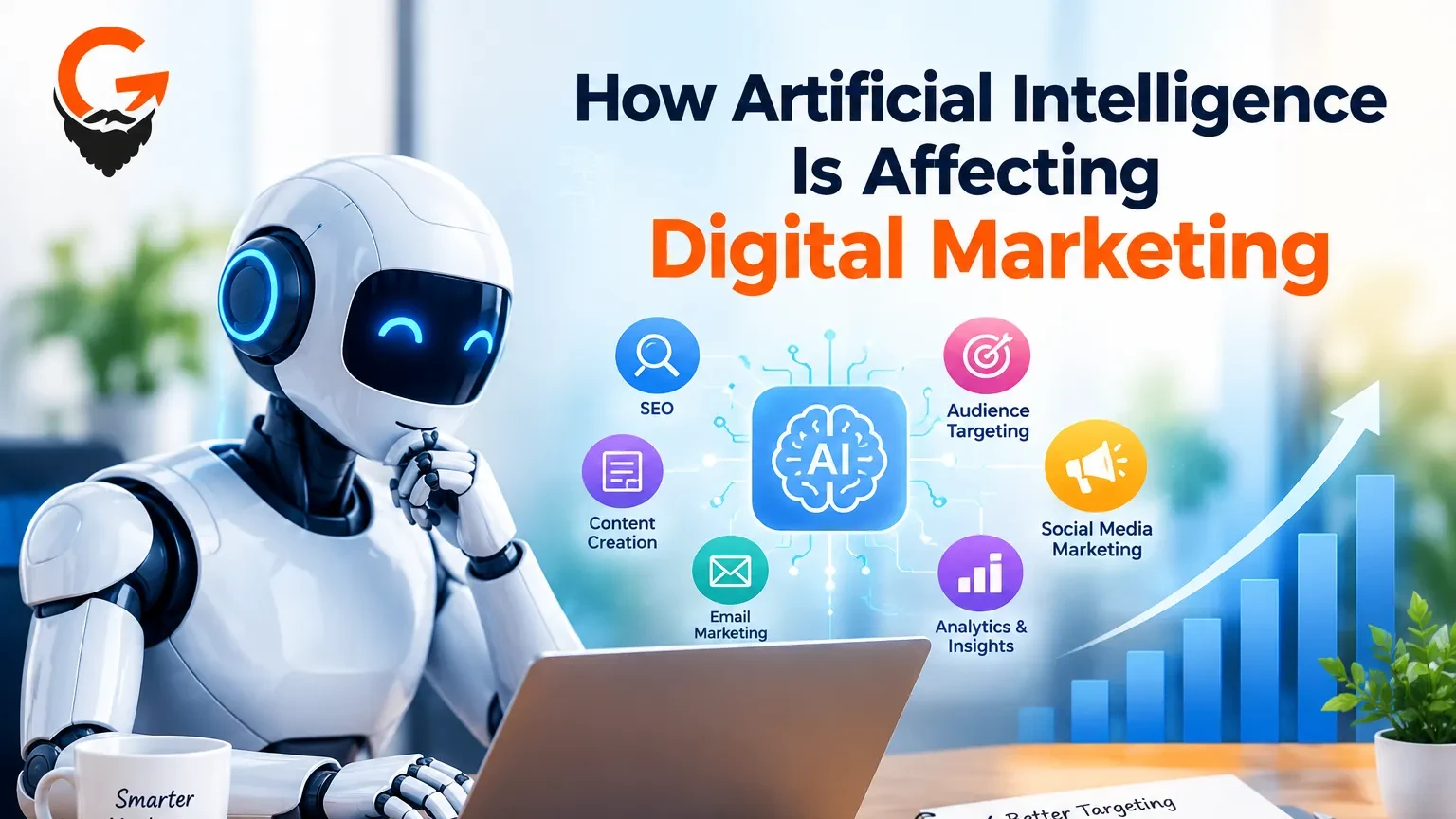
How Artificial Intelligence Is Affecting Digital Marketing || Latest Trends in 2026
- Introduction: The Evolution of Digital Marketing
- What Is Artificial Intelligence in Digital Marketing?
- Some Important AI Tools in Digital Marketing
- Will AI Replace Digital Marketers?
- How to Make Successful Marketing Stick in the AI Era
- Top 5 Digital Marketing Trends in 2026
- How AI Is Changing the Core of Digital Marketing
- AI vs. Human Marketing: Why Human Input Still Matters
- Challenges of Using AI in Digital Marketing
- Key Benefits of AI for Small Businesses
- Final Thought: Building an AI-Powered, Human-Centered Future
- Frequently Asked Questions
Digital marketing is a process where businesses introduce their brands, services, or products using online platforms such as websites, SEO, PPC, and social media marketing apps. Marketers are increasingly using AI for their business growth. AI allows simple campaign execution, budget planning, and selecting campaign goals. It has also become much easier to manage social media with the use of AI.
The best digital marketing tools manage data, creativity, and technology to support your digital marketing strategy. They can be used to help you find out more about audiences, make better content and resources, track performance, look for new opportunities, and allow more intelligent decisions. They improve your visibility, interaction, traffic, conversions, and overall growth for your business. Working with a leading Digital Marketing Agency in USA helps brands leverage cutting-edge AI technologies alongside seasoned human expertise to achieve sustainable growth.
Introduction: The Evolution of Digital Marketing
Digital marketing emerged in the 1990s, and Philip Kotler is widely considered the father of digital marketing. He was a marketing expert at an American university and is deeply associated with modern marketing. Additionally, Dr. Karl Rehnberg is regarded as the father of network marketing. While the initial focus was on traditional marketing methods, digital marketing gradually established itself as a powerful, transformative force in the global business world.
Today, digital marketing is evolving at a faster rate than ever before, with new tools, techniques, and strategies rolling out every single year. Businesses need to stay ahead of this rapid change to remain relevant, competitive, and successful online. From artificial intelligence and modern SEO tools to analytics and automation, selecting the perfect digital marketing stack brings direct commercial success.
It is absolutely true that AI has made its presence felt across the entire field of digital marketing. Whether it is SEO, PPC marketing, social media marketing, or custom web development, AI tools are making tasks faster, smarter, and significantly easier in every area.
What Is Artificial Intelligence in Digital Marketing?
AI in digital marketing means using smart technologies to analyze data, rapidly address customer needs, and continuously improve marketing strategies. You have likely seen how modern AI can process vast amounts of content in mere minutes; it excels at understanding user behavior—whether it involves search queries, click patterns, or online buying activity.
AI is applied in digital marketing in various high-impact ways, such as:
AI assists in attracting potential customers and delivering highly relevant ads to the right audience at the right moment. In email marketing, it assists by analyzing historical user interactions to deliver content that is genuinely helpful and timely. However, AI should never be used to replace human creativity entirely. Instead, AI has emerged as an indispensable co-pilot in modern digital marketing. When human knowledge and verified data are combined with AI automation, businesses save immense time, enhance customer experiences, and build long-term sustainable strategies.
Some Important AI Tools in Digital Marketing
Marketers in 2026 rely on a curated suite of specialized AI tools to manage creativity, technical optimization, and automation across their marketing funnels. Here are the most essential AI tools currently shaping digital marketing:
1. ChatGPT (OpenAI)
ChatGPT is an industry-leading conversational AI tool developed by OpenAI. It helps marketers generate targeted answers, brainstorm campaign themes, draft blog outlines, compose email variations, and write engaging social captions based on custom prompts.
2. Gemini (Google)
Gemini is Google's powerful multimodal AI model. It excels at synthesizing live search engine data, processing complex documents, analyzing competitor strategies, and delivering real-time insights integrated directly with the Google ecosystem.
3. Claude (Anthropic)
Claude is widely recognized for its deep contextual comprehension, safety guardrails, and remarkably natural writing style. It is ideal for long-form content research, technical documentation, brand voice consistency, and high-level reasoning tasks.
4. Surfer SEO Tool
Surfer SEO is the top recommendation for on-page SEO optimization and content scoring. It analyzes top-ranking SERP competitors in real-time, guiding writers on keyword frequency, heading structures, NLP terms, and ideal content length to secure top search rankings.
5. Canva AI (Magic Studio)
Canva AI empowers marketing teams to instantly generate social media posts, presentations, marketing banners, and visual assets without needing an advanced design background. Its Magic Design and AI image generation tools dramatically shorten creative turnaround.
6. Grammarly
Grammarly provides advanced grammar checking, sentence rephrasing, vocabulary enhancement, and tone refinement. Clear, error-free communication is fundamental to professional marketing, and Grammarly ensures every piece of content maintains readability and trust.
7. HubSpot AI
HubSpot AI integrates marketing automation, CRM management, predictive lead scoring, and automated email nurturing. It helps marketing and sales teams track customer touchpoints, draft outreach sequences, and optimize conversion paths effortlessly.
8. Copy.ai
Copy.ai is purpose-built for high-velocity marketing and sales copywriting. Marketers use it to generate product descriptions, Facebook ad copy, sales sequences, and short-form social media updates with quick prompt frameworks.
Will AI Replace Digital Marketers?
Not really! While AI has automated many repetitive tasks and is performing exceptionally well, human judgment is still absolutely required to decide which tools to prioritize, how to interpret nuance, and which strategies are best suited for each unique business. Here are key points that justify why human marketers remain irreplaceable:
- A) Strategic Roles vs. Repetitive Execution: Artificial intelligence is threatening roles heavily reliant on routine execution, but marketers who are strategic, empathetic, and directly responsible for revenue results are much more difficult to substitute.
- B) The Wisdom to Challenge and Ignore AI: The real competitive value isn't merely inside the AI algorithm. The true value lies in human wisdom—the ability to verify facts, question assumptions, challenge robotic suggestions, and occasionally ignore AI recommendations in favor of genuine customer insights.
- C) Marketing in Transition to Revenue Responsibility: Modern marketing has shifted from basic manual channel management to full systems impact, brand positioning, and bottom-line revenue accountability—areas where human leadership and business acumen are paramount.
- D) Eliminating Tedium to Focus on Decisions: Successful marketers harness AI to eliminate repetitive manual work, allowing them to reinvest their energy into creative breakthroughs, relationship building, and high-impact decision-making that drives businesses forward.
How to Make Successful Marketing Stick in the AI Era
Successful marketing goes far beyond automated algorithms; it involves building lasting trust, shaping a memorable brand identity, and engaging with a wider community of like-minded individuals. In the years ahead, digital marketing will firmly be a collaborative Human + AI partnership. Marketers that effectively harness the analytical power of AI will save valuable time, make smarter data-backed choices, and execute with greater strategic agility.
Top 5 Digital Marketing Trends in 2026
The digital landscape in 2026 is defined by rapid technological maturation and heightened user expectations. Businesses aiming for sustainable visibility must adapt to these five defining trends:
1. AI-Powered Digital Marketing
AI is now deeply integrated into daily marketing workflows. It actively helps marketers to Create content Process, analyze big data, personalize marketing campaigns, and deliver superior customer experiences across every digital touchpoint.
2. Search Generative Experience (SGE) & AI Search
Search is fundamentally evolving with AI-generated answers. Search engines now present direct, conversational summaries via AI snapshots (Google SGE, Perplexity, Gemini). Companies require authoritative, clearly structured, and valuable copy that gets cited within AI-driven answers.
3. Human-Focused Content (E-E-A-T)
Google prioritizes content centered on Experience, Expertise, Authoritativeness, and Trustworthiness (E-E-A-T). The more straightforward, intent-focused, and authentic your content is, the higher its ranking potential. Genuine human-written insights are indispensable for long-term SEO success.
4. Short-Form Video Marketing
Short-form video formats across Instagram Reels, TikTok, and YouTube Shorts remain the most captivating medium to capture consumer attention, explain complex products or services, and generate rapid social sharing and virality.
5. Hyper-Personalized Marketing
Generic marketing broadcasts are losing effectiveness. Modern customers expect relevant, individualized messaging. Businesses are leveraging unified customer data and AI automation to deliver tailored emails, personalized dynamic ads, and customized on-site buying journeys.
How AI Is Changing the Core of Digital Marketing
Artificial intelligence has revolutionized digital marketing by accelerating day-to-day operations and unlocking deeper comprehension of customer psychology. It allows marketers to ideate faster, anticipate consumer behavior, and continually refine marketing assets while automating tedious operational overhead.
Key Ways AI Is Changing Digital Marketing:
- Content Creation: Accelerates initial drafts for blog writing, social media captions, email outreach sequences, and structured outlines.
- SEO & Search: Uncovers search intent, identifies long-tail semantic patterns, analyzes SERP features, and optimizes technical crawlability.
- Advertising & PPC: Optimizes ad copy variants, predicts click-through rates, refines automated bid strategies, and pinpoints high-value audience segments in real-time.
However, AI must serve to support marketers rather than completely replace their unique expertise. Human creativity, real-world experience, diligent fact-checking, and deep emotional resonance remain essential for producing trustworthy and truly effective marketing campaigns.
AI vs. Human Marketing: Why Human Input Still Matters
While AI makes digital marketing significantly faster and more data-driven, human input remains irreplaceable. AI algorithms analyze data and generate patterns, but they do not possess personal life experiences, emotional empathy, moral intuition, or genuine understanding of a brand's unique soul.
Why Human Input Matters:
The optimal modern approach is not AI vs. Humans, but rather AI + Humans working together. AI handles heavy computation, pattern recognition, and repetitive execution, while experienced marketers supply direction, creativity, critical judgment, and authentic empathy.
| AI in Digital Marketing | Human Marketers & Input |
|---|---|
| Processes millions of data points in seconds | Formulates creative strategy, positioning, and vision |
| Generates fast drafts, outlines, and summaries | Infuses proprietary stories, humor, and brand voice |
| Prone to hallucinations and generic cliches | Diligently fact-checks and verifies industry accuracy |
| Automates PPC bidding and audience grouping | Aligns ad campaigns with high-level business goals |
| Lacks consciousness and genuine human emotion | Builds authentic emotional rapport and lasting trust |
Challenges of Using AI in Digital Marketing
While artificial intelligence offers unmatched operational speed, deploying it without governance introduces notable business and marketing risks:
Key Benefits of AI for Small Businesses
Artificial intelligence is helping small businesses improve their marketing, save time, and manage daily operations more efficiently than ever before. With the right AI tools, small enterprises can compete effectively against enterprise competitors, understand customer needs deeply, and make agile business decisions without needing large in-house teams.
By automating repetitive manual tasks, small business owners and marketing teams can focus their attention on strategic direction, product excellence, and personal customer relationships. AI empowers small businesses to create personalized marketing campaigns, optimize budget allocation in paid ads, monitor consumer trends, and scale lead generation cost-effectively.
Final Thought: Building an AI-Powered, Human-Centered Future
AI is transforming digital marketing by making tasks faster, smarter, and significantly more efficient. However, successful marketing will always require human creativity, strategic wisdom, practical experience, and genuine empathy. Businesses should embrace AI as an indispensable tool rather than a total replacement for human talent. The highest ROI comes from uniting modern AI capabilities with verified human expertise.
Ready to Elevate Your Digital Marketing with Smart AI & Human Strategy?
Partner with Guru Digital Advertising to design data-driven campaigns, rank at the top of search engines, and convert visitors into loyal customers across the United States.
Get a free website audit or consultation with our digital marketing specialists today.
Get Started With Guru Digital Advertising — Contact UsFrequently Asked Questions
What is the 30% rule for AI in marketing?
In general terms, the 30% rule for AI means that everything produced with AI assistance should not be published without human input, fact-checking, and editing. AI is a powerful tool marketers can leverage to brainstorm ideas, conduct research, and draft initial content, but it requires human editing by an industry specialist who injects verified facts, brand voice, and genuine expertise.
Is AI going to replace digital marketing?
No, AI is unlikely to completely replace digital marketing. While it automates repetitive tasks, analyzes complex data, generates content drafts, and optimizes paid advertising, human creativity, strategic positioning, emotional understanding, and executive decision-making remain essential. Instead of replacing marketers, AI transforms how they work and helps them become significantly more productive.
What will AI change in digital marketing in 2026?
By 2026, AI is revolutionizing digital marketing through AI-powered automation, predictive analytics, and Search Generative Experience (SGE). Content creation has become faster, customer experiences are hyper-personalized, search algorithms prioritize intent and E-E-A-T, and promotional distribution is automated. Marketers use AI to analyze customer data, uncover fresh market opportunities, test campaigns, and automate customer touchpoints—all while steering strategy with a human touch.
What are the applications of AI in digital marketing?
Key applications of AI include SEO optimization (search intent discovery and keyword research), automated social media scheduling, predictive email marketing, customer service chatbots, audience segmentation, programmatic ad bidding, and dynamic personalization. While AI assists marketers in processing vast volumes of data and saving time, human marketers hold the final strategic responsibility.
What are the advantages of using AI in digital marketing?
AI delivers significant time savings and task automation, allowing for a far more efficient execution of marketing campaigns. It analyzes behavioral patterns from current customers and identifies lookalike audiences across the internet to improve ad targeting and conversion rates. Diligent human oversight remains crucial to ensure accuracy, originality, and brand alignment.
Can artificial intelligence be used for small business digital marketing?
Yes! Small businesses can leverage AI to level the playing field against larger competitors. Affordable AI tools can be used for content ideation, social media captions, email marketing sequences, customer support bots, data analysis, and ad optimization. Balancing AI efficiency with human expertise delivers the greatest long-term marketing ROI.
Ready to Accelerate Your Digital Growth?
Speak directly with our senior growth strategists. We audit your campaigns, identify conversion bottlenecks, and provide an actionable roadmap.
Book a Strategy Consultation